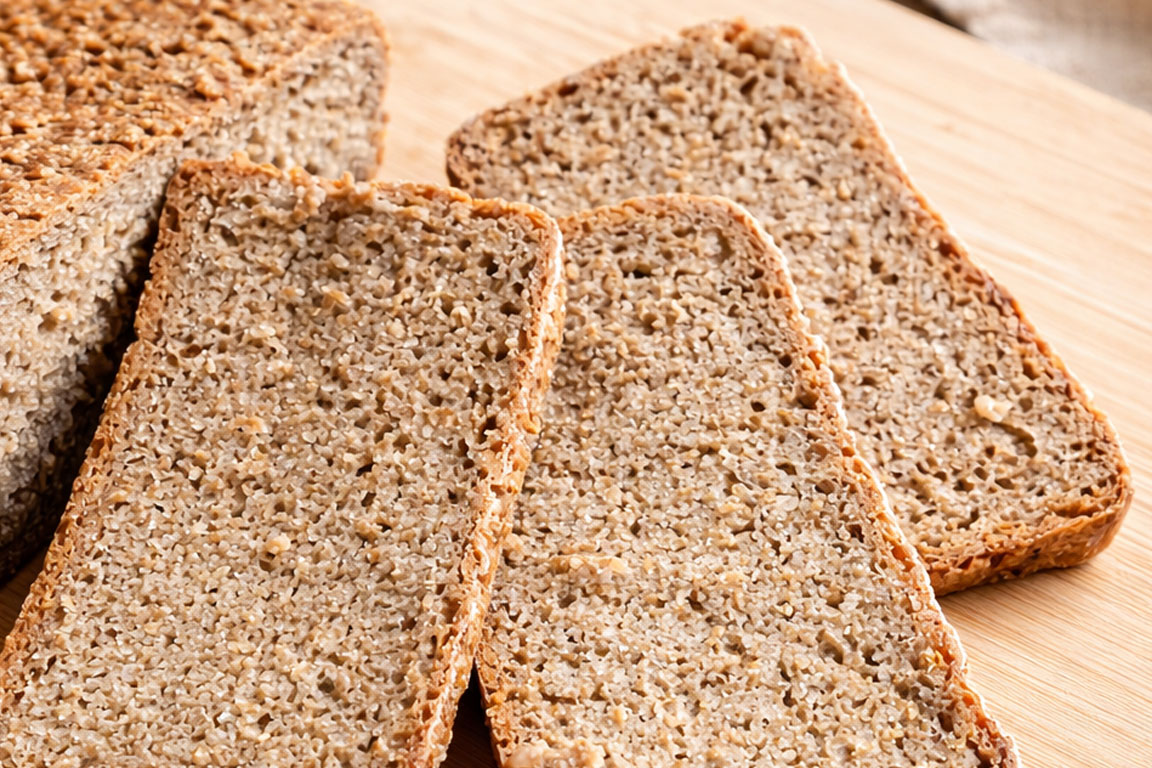
Rye Sourdough
A thoughtfully refined rye sourdough. The flour is sieved, with the bran and germ toasted before being added back into the dough. This creates a deeper, nuttier flavour while helping produce a more even, manageable crumb — a beautiful balance of tradition and technique.
Ingredients
- 156 g active rye sourdough starter
- 442 g luke warm water
- 520 g rye flour
- 1.3 tsp salt
- 2.6 Tbsp vital wheat gluten (optional)
Instructions
- Add water and sourdough starter to the Thermomix bowl. Mix 5 sec / speed 4.
- Add rye flour and salt (and vital wheat gluten if using). Mix 10 sec / speed 4, scrape down, then mix 5 sec / speed 4.
- The mixture should be a thick, sticky paste rather than a dough.
- Bulk Ferment
- Leave in the bowl or transfer to a container and cover loosely.
- Allow to ferment for 3–5 hours in a warm place (around 22–26°C), until slightly risen with small cracks forming on the surface.
- Shape
- With wet hands or spatula, transfer the mixture into a loaf tin. Smooth the top.
- Optional: Lightly dock the surface with a wet finger or skewer. (giving somewhere to release pressure)
- Final Proof
- Leave to prove for 1–2 hours, until slightly puffed with fine cracks on the surface. Do not wait for a large rise.
- Bake
- Preheat oven to 220°C.
- Bake for 15 minutes at 200°C, then reduce to 180°C and bake for a further 45–55 minutes.
- Optional: Place a small dish of water in the oven for steam.
Notes
Expect a different texture
This is a dense, moist loaf, not light and airy like white bread. That’s exactly what you want with 100% rye. Your starter matters
Use your starter when it’s active and airy underneath. Rye starter often looks flat on top and light and spongy inside. Don’t overproof
Rye doesn’t need a big rise. A slight puff and a few cracks on the surface are enough before baking. Keep it warm
A warm kitchen helps fermentation. If your space is cooler, allow a little extra time. Tin Size
200 ong x 110 wide x 110 high Let it rest before slicing
This is the most important step. Leave the loaf for 12–24 hours before cutting so it can fully set; this prevents a gummy texture. Serving
Slice thinly and serve with butter, cheese, or your favourite toppings. This rye loaf also toasts beautifully, bringing out its rich flavour. Alternative Flavours
Sifted Rye & Dry-fry the Bran and Gerrm
This is a dense, moist loaf, not light and airy like white bread. That’s exactly what you want with 100% rye. Your starter matters
Use your starter when it’s active and airy underneath. Rye starter often looks flat on top and light and spongy inside. Don’t overproof
Rye doesn’t need a big rise. A slight puff and a few cracks on the surface are enough before baking. Keep it warm
A warm kitchen helps fermentation. If your space is cooler, allow a little extra time. Tin Size
200 ong x 110 wide x 110 high Let it rest before slicing
This is the most important step. Leave the loaf for 12–24 hours before cutting so it can fully set; this prevents a gummy texture. Serving
Slice thinly and serve with butter, cheese, or your favourite toppings. This rye loaf also toasts beautifully, bringing out its rich flavour. Alternative Flavours
Sifted Rye & Dry-fry the Bran and Gerrm
Tried this recipe?Let us know how it was!
