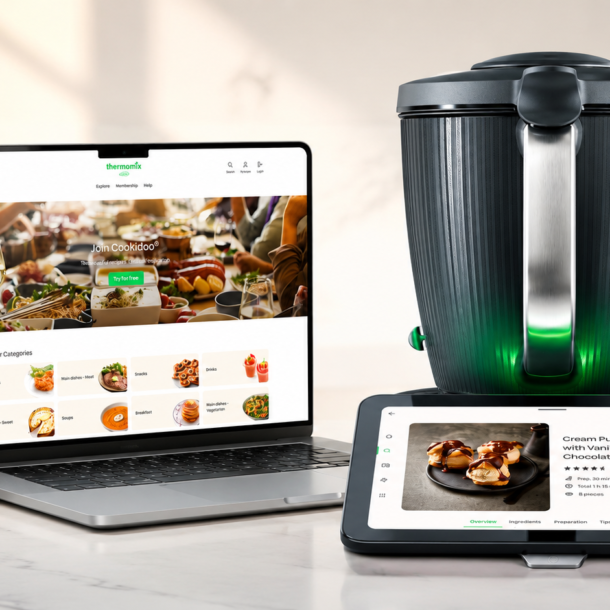

When people first see a Thermomix in action, they are usually amazed.
It chops in seconds, kneads dough effortlessly, cooks sauces perfectly, steams entire meals, and somehow replaces a bench full of kitchen appliances all at once.
Most demonstrations focus on the “wow factor,” and understandably so. The machine is impressive.
But after years of helping people learn their Thermomix properly, I’ve realised something important:
The things that truly determine whether someone loves their Thermomix long-term are often the things that are missed in the beginning.
Most consultants are passionate and genuinely helpful. But often there simply isn’t enough time during a demo to explain the deeper understanding behind how the machine actually works.
And that deeper understanding changes everything.
Because the Thermomix is not just a machine that follows recipes. It is a cooking system. Once you understand why it behaves the way it does, cooking becomes easier, more flexible, and far more intuitive.
No judgement at all, but there are a few things about Thermomix that don’t always get explained fully.
One of the biggest misunderstandings about the Thermomix is that it only works if you follow guided recipes exactly through Cookidoo.
Guided cooking is fantastic. It gives people confidence, structure, and consistency. For busy families, especially, it can completely remove the mental exhaustion of deciding what to cook every night.
But the real magic of the Thermomix starts when you stop relying entirely on recipes.
Many people don’t realise that the Thermomix can become an extension of the way they naturally cook. Once you understand temperatures, speeds, blade direction, and ingredient behaviour, you begin adapting recipes confidently, substituting ingredients easily, and creating meals from what you already have at home.
That’s when the machine truly becomes life-changing.
Instead of:
“What recipe should I follow?”
You start asking:
“What do I want to make?”
That shift is enormous.
One of the most overlooked aspects of the Thermomix is speed control.
Every speed in the Thermomix serves a different purpose.
Low speeds gently stir and protect ingredients.
Medium speeds combine and emulsify.
Higher speeds chop, mill, and pulverise.
Understanding this is one of the keys to mastering the machine.
For example:
A single speed adjustment can completely change the outcome of a recipe.
This is especially important when making:
Many recipe failures are not because the Thermomix “didn’t work.” They happen because people didn’t understand what the speed settings are actually designed to do.
The butterfly whisk has several important purposes:
It changes how ingredients move through the bowl.
This matters enormously when making things like:
One critical detail is that the butterfly is designed for a maximum of speed 4.
Going beyond that can dislodge the butterfly or overwork ingredients.
Small details like this are the difference between frustration and confidence.
One of the hardest adjustments for experienced cooks is realising that the Thermomix does not cook the same way as a saucepan on a stove.
The heating system is different.
The bowl structure is different.
Steam circulation is different.
Heat retention is different.
This affects almost everything.
For example:
Understanding residual heat alone improves cooking dramatically.
Many people overcook sauces or curdle mixtures simply because they don’t realise the bowl continues holding significant heat after the cooking process finishes.
The Thermomix is incredibly precise, but it also behaves differently from traditional cookware, and learning those differences is part of becoming confident with it.
Scraping the bowl is actually one of the most important habits you can develop.
Why?
Because ingredients sitting above the blades are not being processed evenly.
This affects:
When making things like dips, sauces, curry pastes, nut butters, or chopping vegetables, ingredients often climb the sides of the bowl during processing.
If they stay there, the blades cannot work on them properly.
The result?
Chunky sauces, uneven chopping, or inconsistent mixtures.
The Thermomix is powerful, but physics still matters. Ingredients must be brought back into the working zone of the blades for proper processing.
Reverse mode changes the direction of blade rotation so the blunt edge of the blades interacts with ingredients rather than the sharp cutting edge.
This allows the Thermomix to:
Without reverse mode, chicken can quickly become shredded. Vegetables can become mushy. Pasta can break apart.
With reverse mode, dishes maintain texture beautifully.
This is particularly important for:
Understanding when to use reverse mode is one of the biggest confidence builders.
Breadmaking in the Thermomix can be incredible, but it also teaches people something important:
Recipes are guides, not guarantees.
Many users expect:
“If I follow the recipe exactly, my dough should always look identical.”
But dough is affected by:
Especially when working with sourdough or wholegrain flours, the dough itself tells you what it needs.
Some days it needs more water.
Some days less.
Understanding dough texture is far more important than obsessing over exact timings.
This is where confidence and experience become more important than blindly following instructions.
And this is often the point where people move from simply using a Thermomix… to genuinely learning how to cook.
Most people think the measuring cup only exists for measuring ingredients.
But it actually plays several important roles:
Leaving the measuring cup on creates a very different cooking environment compared to leaving it off.
For example:
Understanding this helps explain why identical recipes can produce different consistencies depending on whether the measuring cup is used.
Tiny detail. Massive impact.
Cleaning is another area people often underestimate.
A poorly cleaned Thermomix bowl can affect:
Many people are amazed at how easily the Thermomix cleans itself when done correctly.
One of the simplest and most effective methods is:
This lifts residue quickly and keeps the bowl fresh.
Good cleaning habits also extend the life of the machine and improve everyday cooking performance.
Perhaps the most important thing consultants don’t always explain properly is this:
The Thermomix is not really about technology.
It’s about confidence.
For many people, cooking feels stressful:
The Thermomix reduces that overwhelm, helping people feel capable again.
And once people gain confidence, they cook more often, waste less food, experiment more freely, and enjoy the kitchen again.
That emotional shift is often far more valuable than any individual feature of the machine.
The Thermomix is one of the most intelligent kitchen systems ever created, but understanding why it works is what unlocks its real potential.
Not just:
“What button do I press?”
But:
Those deeper explanations are what transform someone from simply following recipes into truly understanding their cooking.
And once that happens, the Thermomix stops being just another appliance on the bench.
It becomes one of the most valuable tools in the entire kitchen.