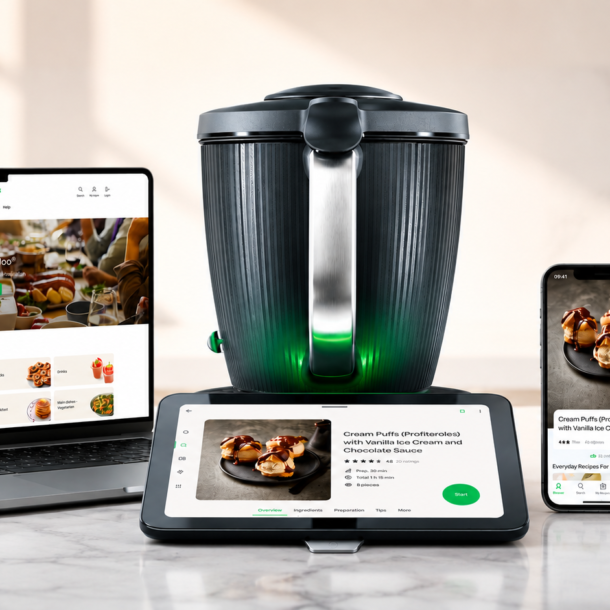

When you first look at a Thermomix, you notice its cooking functions, touchscreen, guided recipes, and ability to chop, knead, steam, blend, and cook all in one machine. But quietly built into the base of every Thermomix is one of its most powerful and time-saving features: the integrated scales.
At first glance, they may seem like a simple convenience. In reality, the Thermomix scales completely change the way you cook, bake, meal prep, and even clean up. Once you become used to weighing ingredients directly into the bowl, it becomes surprisingly difficult to go back to traditional kitchen scales.
For many Thermomix users, the scales become one of the most used features of the machine, sometimes even more than the cooking itself.
This article explores everything you need to know about Thermomix scales: how they work, why they matter, how accurate they are, common frustrations, troubleshooting tips, and how they help create faster, simpler, and more enjoyable cooking.
Traditional kitchen scales require:
The Thermomix eliminates all of that.
The scales are built directly into the machine, allowing you to weigh ingredients straight into the mixing bowl as you cook. This means you can:
There is no transferring ingredients between bowls, no guessing measurements, and far less washing up afterwards.
This may sound like a small thing, but when you cook regularly, it becomes a huge time saver.
One of the most common questions people ask:
“Are the Thermomix scales actually accurate?”
The answer is yes.
The TM6 and TM7 scales measure in 1-gram increments and can weigh up to 3 kg at a time or up to 6 kg in stages.
For everyday cooking and baking, this level of precision is excellent.
The scales are accurate for:
In fact, many users find they become more accurate cooks after owning a Thermomix because weighing ingredients becomes so effortless.
Instead of estimating cups and spoons, people naturally begin cooking by weight, which is often far more reliable.
Cooking by weight is one of the biggest shifts many Thermomix owners make.
Traditional recipes often rely on:
But these measurements can vary enormously depending on:
For example:
Grams are exact.
This is why professional bakers and chefs almost always work by weight.
The Thermomix encourages this naturally because the scales are always there and always ready.
Baking is where the Thermomix scales truly shine.
Baking relies heavily on precision:
Because the scales are integrated, recipes become:
You simply:
No extra bowls.
No transferring.
No mess.
This is especially helpful when making:
One of the most important features of the Thermomix scales is the tare button.
“Tare” simply means resetting the scales back to zero while leaving the current ingredients in the bowl.
For example:
The Thermomix automatically calculates each ingredient separately without needing extra bowls.
Once you get used to this system, cooking becomes incredibly streamlined.
A feature many people do not realise is that Thermomix scales can often be used while cooking.
On the TM6, weighing can occur while mixing up to speed 4.
On the TM7, weighing during operation is recommended up to speed 2 for best accuracy due to vibration sensitivity.
This means you can:
This creates a very fluid cooking experience.
People often underestimate how much time is spent:
The Thermomix removes almost all of this.
Instead of:
You simply:
All in one place.
For busy families, this becomes incredibly valuable.
This is one of the biggest hidden benefits.
Traditional baking may involve:
With Thermomix, many recipes use:
That is a huge reduction in kitchen mess.
Sometimes users feel the scales are inaccurate when, usually, there is another cause.
The most common issues are:
Thermomix scales are extremely sensitive.
The machine should sit:
Uneven surfaces can affect readings.
If the power cord is:
it can slightly affect the scale mechanism.
This is surprisingly common.
The Thermomix scales work best when ingredients are added steadily.
Very tiny amounts sprinkled slowly may not immediately register.
For small quantities:
If the machine is bumped or moved while weighing, the reading may shift.
For example:
may briefly jump between numbers before settling.
This is completely normal for digital scales.
For most home cooking, it makes no practical difference.